Medicare Advantage Overview
Medicare Supplement Plans (Medigap)
What is Medicare Supplemental Insurance?
Medicare Supplemental Plans Coverage
Medicare Supplements Plans – Standardized Plans
What are the different Medicare Supplements Plans?
How do I pick a Medicare Supplement plan?
Medicare Supplemental Plans – Open Enrollment
Medicare Supplement Plans – Guaranteed Issue
Medicare Supplement Plans- Underwritten
What is the Best Medicare Supplemental plan?
Common Questions about Medicare Supplemental Insurance
What is the open enrollment period for Medicare supplemental plans?
Can you change Medicare supplements anytime?
What is guaranteed issue for Medicare supplemental insurance?
Medicare Supplement Plans (Medigap)
Medicare Supplement plans cover 13.5 million Medicare beneficiaries. Also referred to as Medigap plans, these policies help pay for your share of Medicare expenses, such as your deductibles and co-insurance. Medicare supplement insurance plans are available for purchase in all 50 states and are very popular with people who want little to no copays when they access healthcare services.
Many people new to Medicare feel surprised to find that Medicare covers only 80% of your Part B expenses. The other 20% can be devastating to you financially if a serious illness arises. You can choose a Medicare Supplement that will pay some or all of that 20% for you, among other things. Supplemental insurance for seniors with Medicare essentially buys you peace of mind by eliminating that cost-sharing responsibility.
MEDICARE SUPPLEMENT (MEDIGAP)

DOCTOR BILLS
Your doctor provides a medical service and bills Medicare

MEDICARE PAYS
Medicare pays the approved portion of the bill and sends the excess amount to Medigap

MEDICAL PAYS
Your Medigap plan pays the excess amount left over, according to the plan’s terms
Medicare Part B only covers 80% of your medical expenses. Medicare Supplement (Medigap) plans help pick up the excess costs.
Also, during your one-time open enrollment window, you are guaranteed the right to purchase a Medicare supplement plan. Your health status does not matter when you buy a plan during this six-month window.
What is Medicare Supplemental Insurance?
Medicare Supplements were offered to the Medicare Beneficiaries shortly after Medicare was signed into law. Since Medicare has internal coverage gaps, making consumers that have Medicare only cover part of the cost, Medicare Supplements allowed consumers to purchase insurance through private Insurance companies, lowering or doing away with these additional costs. These plans have allowed people to worry less about unexpected costs, while keeping their premium level.
Some of the primary advantages of a traditional Medicare supplement policy are:
- Freedom to choose your own doctors and hospitals
- No referrals required to see a specialist
- Predictable out-of-pocket expenses for Medicare-covered services (and zero out-of-pocket with Plan F)
- Nationwide coverage – you can use it anywhere in the United States
- Guaranteed renewability – the insurance company can never drop you or change your coverage due to a health condition
Supplemental insurance for seniors with Medicare is the most predictable back-end coverage that you can buy. You will know exactly what’s covered for every inpatient or outpatient procedure based on which Medigap plan you choose.
Some of the primary advantages of a traditional Medicare supplement policy are:
- You must have Part A and Part B to buy a Medigap policy.
- Medicare supplement plans cover only one person. Your spouse must have his or her own individual policy.
- You can drop your supplement at any time. There is no annual election period for Medicare Supplement plans.
- The annual election period in the fall is for drug plans. It does not apply to
- Medicare supplements in any way.
- Many carriers offer household discounts if two or more people enroll in
- Medicare supplemental plans from the same company
- Plans do not include Part D, so you’ll add a separate standalone Part D drug plan

Medigap is insurance to cover your Medicare deductibles & copays
Medicare Supplemental Plans Coverage
Medicare Supplement plans pay after Medicare approves and pays its share of your claim. They are Medicare gap insurance, helping to cover the gaps in Medicare that normally you would have to pay. This includes things like deductibles, coinsurance and copays.
You can use your Medicare Supplement plan at any provider in the nation that accepts Medicare. This makes Medicare supplements great for travel or for people who live in more than one state throughout the year.
Medicare Supplements plans do not include retail drug coverage, so you’ll want to purchase a standalone Part D drug plan for your medications. A Medicare Supplement does not cover routine, dental, vision or hearing services either. Since Medicare itself does not cover these items, so your supplement cannot pay anything toward them either.
Medicare Supplements Plans – Standardized Plans
To see a list of all the Medicare supplemental plans available – take a look at our Medigap supplement chart below. This chart appears in the “Choosing a Medigap,” booklet published by Medicare itself. It details the benefits covered by each different plan. If you would like a copy for yourself, please request information to your right and we will provide a free copy for your review.
Some of our clients have found Medicare’s handbook hard to read, so here on our site, we’ve tried to use simpler terms. Our pages about the different Medicare supplements include examples of how the coverage would pay. This will help you understand how they work in real situations.
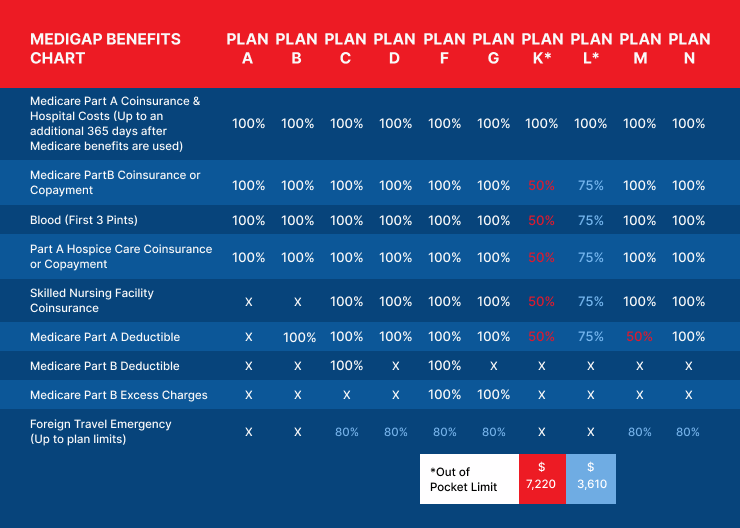
*Medigap Plan F is also offered as a high-deductible plan (HDF) by some insurance companies in some states. If you choose the high-deductible option, it means you must pay for Medicare-covered costs (coinsurance, copayments, deductibles) up to the deductible amount of $2340 in 2020 before your policy will pay anything.
**For Medigap Plans K and L, after you meet your annual out-of-pocket limit and your annual Part B deductible ($240 in 2025), the Medigap plan pays 100% of covered services for the rest of that calendar year.
***Plan N pays 100% of the Part B coinsurance, except for a copayment of up to $20 for some office visits and up to a $50 copayment for emergency room visits that don’t result in an inpatient admission.”
(Note: The copayment amounts for Plan N have not changed in 2025—they remain $20 for office visits and $50 for ER visits.)
****Medigap Plan G also has a high-deductible option. In 2025, the HDG deductible is $2,800. To learn more about this plan, fill out the contact form, and one of our professionals will gladly walk you through any questions you have.
What are the different Medicare Supplements Plans?
Each Medicare supplement plan in the chart above has a letter, A – N. Each plan letter provides a different set of benefits. However, each lettered plan must have the same standardized coverage regardless of which insurance company you choose. For example, Medicare supplement Plan G through Humana will be the same benefits as a Plan G through Anthem or United Healthcare.
The Medicare supplement chart below shows the 10 standardized Medicare supplement plans. These plans can be offered by insurance companies in most states. Wisconsin, Minnesota and Massachusetts have different options though.
There is one Medigap plan that covers all gaps in Original Medicare, leaving you with $0 out-of-pocket costs—Plan F*. However, Plan F is only available to those who became eligible for Medicare before January 1, 2020.
If you prefer lower premiums in exchange for some cost-sharing, you might consider Plans G or N. These plans require you to pay a few small out-of-pocket costs (like the Part B deductible with Plan G or copays with Plan N), but they offer significant savings on monthly premiums compared to Plan F.”*
(Plan F is no longer available to new Medicare enrollees as of 2020, but those who already had it can keep it.)*
How do I pick a Medicare Supplement plan?
Most beneficiaries choose Medigap Plans F, G, or N because they offer the most comprehensive coverage. The reason for these options is simple: Medicare Supplement plans let you decide what matters most for your budget and healthcare needs.
-
If you want minimal out-of-pocket costs, Plan F* covers all Medicare gaps, leaving you with $0 in deductibles or copays. (*Only available if you became eligible for Medicare before January 1, 2020.)
-
If you prefer lower premiums in exchange for small out-of-pocket costs, Plan G covers everything except the Part B deductible ($240 in 2025).
-
For even greater savings, Plan N offers lower premiums but includes small copays ($20 for office visits, $50 for ER visits) and does not cover Part B excess charges.
The right plan depends on whether you prioritize predictable costs upfront (premiums) or flexibility with occasional out-of-pocket expenses.
Medicare Supplemental Plans – Open Enrollment
According to Medicare’s guidelines, the best and easiest time to buy a Medigap policy is during your one-time Open Enrollment window.
-
When It Starts:
-
Begins on the first day of the month you turn 65 (or older) and enroll in Medicare Part B.
-
Lasts for 6 months (it’s a “use it or lose it” opportunity).
-
-
Why It’s Critical:
-
No medical underwriting: Insurers cannot deny you coverage, charge you more, or exclude pre-existing conditions.
-
Guaranteed acceptance: You have the right to buy any Medigap plan available in your state, regardless of health history.
-
After This Window Closes
If you apply later, insurers can:
✔ Require medical underwriting,
✔ Deny coverage based on health, or
✔ Charge higher premiums due to pre-existing conditions.
Important Note:
The Annual Election Period (AEP, Oct 15 – Dec 7) does NOT apply to Medigap plans. Many people mistakenly think they can switch Medigap policies without underwriting during AEP—but this period only affects Medicare Part D (drug plans) and Medicare Advantage.
Bottom Line:
Enrolling during your 6-month Medigap Open Enrollment is the safest and simplest way to secure coverage. Missing this window could mean limited options later.
Medicare Open Enrollment is a one-time window to enroll in any Medicare supplement plan in your area.
Medicare Supplement Plans – Guaranteed Issue
Some beneficiaries delay enrolling in a Medigap plan because they have employer-sponsored group health coverage. However, when that coverage ends (due to retirement or job loss), you have special enrollment rights to purchase a Medigap policy without medical underwriting.
Your Guaranteed Issue Rights
-
Timeframe: You have 63 days after losing employer coverage to enroll in a Medigap plan.
-
Eligible Plans: During this window, you can choose from Plans A, B, C, F, K, or L. (Note: Plan F is only available to those eligible for Medicare before Jan 1, 2020.)
-
No Health Checks: Insurers cannot deny you, charge more, or exclude pre-existing conditions.
Other Guaranteed Issue Scenarios
You may also qualify for guaranteed issue rights if:
✔ Your Medicare Advantage plan leaves your service area (e.g., you move out of state).
✔ Your Medicare Advantage or Medigap insurer violates its contract or goes bankrupt.
✔ You’re in a trial-rights period (e.g., first year of Medicare Advantage).
State Variations Apply
Guaranteed issue rules can differ by state. For example:
-
NY, CT, MA: Have continuous guaranteed issue rights (no limited window).
-
Other States: Follow federal guidelines but may have additional protections.
Key Steps to Protect Yourself
-
Keep Proof of Creditable Coverage: Save termination notices or employer letters—they’re required to avoid Part D penalties and prove eligibility.
-
Act Fast: The 63-day window is strict. Missing it means insurers can use medical underwriting.
-
Consult an Expert: Rules vary by state and situation. Our agency is licensed in 50 states and can help verify your options.

The Annual Election Period does NOT allow you to get a Medigap plan with no health questions.
Medicare Supplement Plans- Underwritten
If your window has already passed for open enrollment or guaranteed issue, you can still apply for a Medicare supplement, but you will have to answer some health questions on your application. The insurance company can accept or decline you.
MISSING YOUR OPEN ENROLLMENT
WHAT HAPPENS IF YOU MISS THIS CRITICAL ONE-TIME OPPORTUNITY?

You missed your one-time open enrollment (or guaranteed issue) period for Medicare supplement.

You can still apply for Medicare supplement but the carrier does not have to accept you.

They will ask you health questions and use that information to accept or decline your application.
Some people are confused by this because they believe the Annual Drug Election Period in the fall is a time when they can change their supplement without underwriting. Unfortunately, the autumn election period only applies to drug plans and Medicare Advantage plans. Changing Medigap carriers will require underwriting in most cases.
Choosing the Best Medicare Supplemental plan
Who Can Still Get Plan F? Plan F (the most comprehensive coverage) remains available only if you became eligible for Medicare Part A before January 1, 2020. If you enrolled in Part A on or after January 1, 2020, your best alternative is Plan G—which offers nearly identical coverage. Always verify eligibility with a licensed broker—rules can vary based on your enrollment history.
How Medigap Plans Work: Every Plan F (or G, N, etc.) must offer identical coverage, regardless of the insurance company. Only price varies—compare premiums, rate increases, and company reputation when choosing. Annual checkups matter—review your plan each year during your birthday month or after a rate hike to ensure you’re still getting the best deal.
Why Plan G Is a Smart Alternative: It’s identical to Plan F except you pay the Part B deductible ($240 in 2025) once per year. It features lower premiums than Plan F (often saving you money annually) and is widely available to all Medicare beneficiaries, even those new to Medicare after 2020. Want the best Plan G rates in your area? Request our free comparison report with quotes and historical pricing trends.
Choosing the Right Plan for You: Since Medigap plans are standardized, your decision comes down to: 1) Coverage level (Do you prefer $0 out-of-pocket costs or lower premiums with small deductibles?), 2) Budget (Compare long-term costs, not just initial premiums), and 3) Insurer reliability (Stable rates? Good customer service?). Need help deciding? Our brokers specialize in matching beneficiaries with the ideal plan—contact us for unbiased advice.
Common Questions about Medicare Supplemental Insurance
What is the average cost of supplemental insurance for Medicare?
Pricing for Medicare supplement policies varies by state. We even see price differences from zip code to zip code in the same county. In some states like Florida, the premiums are higher because the cost of healthcare services in that area is higher. For example, we might be able to find a Plan G for a turning-65 female non-tobacco user for around $100/month in Texas while the same policy would cost more than twice that in Florida.
Most Medicare supplement companies also base their rates on gender, zip code, tobacco usage, and age. Some individuals may also benefit from household discounts. For quotes in your own zip code, give us a call at 1-855-954-0664.
What is the open enrollment period for Medicare supplemental plans?
Your one-time 6-month Medigap Open Enrollment begins when you start Part B. During this window:
✓ Guaranteed approval – no health questions or pre-existing condition exclusions
✓ All plan letters available – choose any Medigap policy
Important: The Annual Election Period (Oct 15-Dec 7) doesn’t apply to Medigap – it’s only for Part D and Medicare Advantage.
After your 6-month window closes:
• Insurers can deny you or charge more based on health
• You may face waiting periods
Act now – this is your only chance for guaranteed Medigap access. Need help? Call 1-855-954-0664.
Can you change Medicare supplements anytime?
You can change almost anytime, excluding:
✓ During Open Enrollment (first 6 months of Part B): No health questions
✓ After: Most states require medical underwriting (insurers can deny or charge more)
Exceptions: CA, OR, CT & WA have special rules allowing easier switching.
Need help navigating your options? Call us.
What is guaranteed issue for Medicare supplemental insurance?
In certain circumstances, an insurance company must accept you for coverage without asking health questions. For example, if you are on Medicaid and you lose your Medicaid eligibility, you have a short window to apply for Medigap without health questions.
Another example would be for someone coming off employer health coverage that is primary to Medicare. They will have a short window to apply for certain Medigap plans under guaranteed issue rules.
Do I really need supplemental insurance with Medicare?
While supplemental insurance is optional, going without it means you’ll be responsible for all of Medicare’s out-of-pocket costs, including:
-
The $1,632 Part A hospital deductible per benefit period
-
20% coinsurance for all Part B services (doctor visits, surgeries, chemotherapy, etc.)
-
Unlimited potential costs since Original Medicare has no annual out-of-pocket maximum
Many beneficiaries find Medicare Supplement (Medigap) plans provide valuable financial protection against these unpredictable expenses. If a Medigap plan doesn’t fit your budget, Medicare Advantage plans offer an alternative with:
-
Lower monthly premiums
-
Built-in out-of-pocket maximums
-
Often include drug coverage
(But require using network providers and may have referral requirements)
The right choice depends on your health needs, budget, and preference for provider flexibility. We can help you compare options.
Find the Right Medicare Supplemental Insurance
When you buy your coverage directly from an insurance company, you give up a lot of benefits. Purchasing through Our Medicare Coach costs exactly the same, but we provide these FREE value-added services for our policyholders.
- What is Medicare : we explain your basic benefits first!
- Quotes for over 40 companies
- Free rate-trend history report so you can see which company has had the lowest rate increases
- Free financial ratings for each company
- Free claims support and help with appeals if Medicare denies a claim
- Full-time Client Service Team to answer your Medicare questions
- Exclusive Clients-Only Webinars each fall to go over the upcoming Medicare changes for next year.
Don’t hesitate to contact our agency for more information and quotes for all of the companies that offer plans in your area. Call 1-855-954-0664 today or fill out the form below for a free assessment.